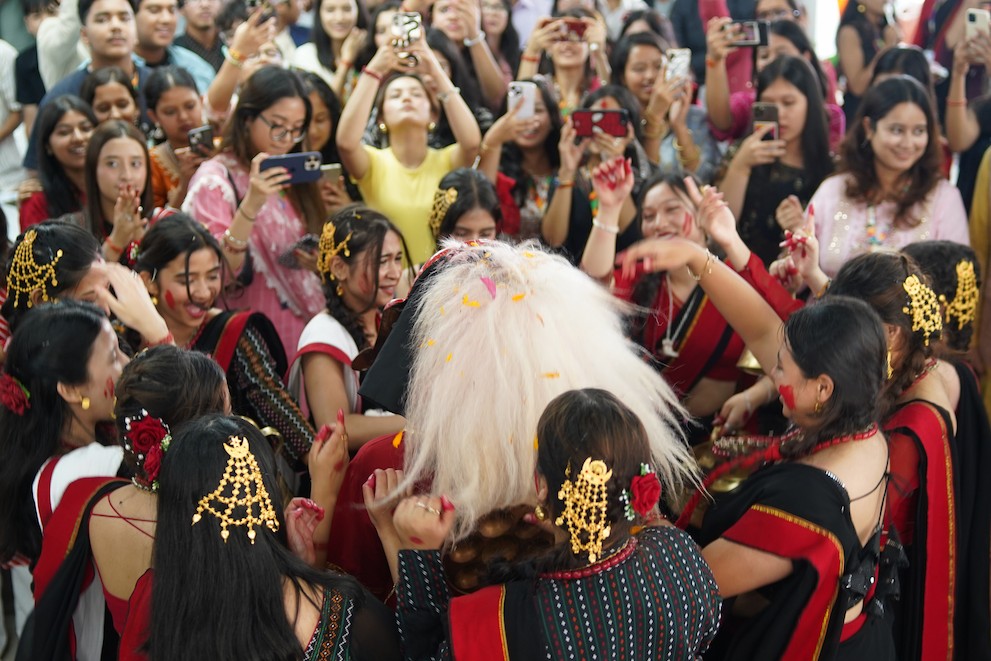
Why and how we do it
What does it mean to vote? Not just to mark a ballot - but to understand why each vote matters, how electoral systems shape outcomes, and what it costs a democracy when citizens disengage. At Kavya School, these questions are not left to a textbook chapter. They have lived, practiced, and debated every year, making Kavya the first higher secondary school in Nepal to bring this level of democratic experience into the classroom.
The Kavya Election Simulation is an annual, curriculum-integrated program where Grade 11 Social Studies students design and administer a fully functioning electoral process, with the whole school - Grades 11 and 12 - participating as candidates, campaigners, and voters, complete with nomination procedures, campaign ethics codes, electoral constituencies, and multi-round voting systems. These are students on the threshold. In a year or two, many of them will cast a real vote for the first time, and some will go on to lead organisations, communities, and institutions. The program mirrors Nepal's own democratic institutions, ensuring that when that moment comes, they are ready, not just as voters, but as citizens who understand what democracy asks of them.
"Rather than learning electoral theory in abstraction, students engage in a hands-on democratic exercise, fostering civic literacy and critical understanding of Nepal's governance framework."
Two Electoral Systems, One Program
One of the programme's most distinctive features is that it does not simulate a single, simplified election. Instead, it replicates two distinct electoral models currently practised in Nepal, teaching students the critical difference between how representatives are chosen at different levels of governance.
System 1: First-Past-The-Post (FPTP) Used in Club StAR elections. Mirrors Nepal's parliamentary and local-level elections, where the candidate with the highest vote count wins.
System 2 : Majority-Based Indirect Election Used for Club President and Club Vice President. Mirrors Nepal's presidential election mechanism, requiring a 50%+1 majority through an Electoral College.
Understanding both systems and their trade-offs is itself a lesson in democratic design. FPTP is fast and decisive; majority-based systems ensure broader legitimacy. By experiencing both, students gain a nuanced perspective that even adults lack.
How the Elections Work
Kavya School organises its student life around 8 clubs, each representing a distinct area of student interest and activity. Every club is led by a Club StAR (Student Activity Representative), a position contested annually through FPTP elections that closely replicate local-level electoral procedures in Nepal.
Club StAR Election: Key Features
Candidates must be nominated and seconded by two club members, mirroring Nepal's local-level nomination rules.
Each candidate submits a written manifesto and selects an election symbol before campaigning begins.
Strict campaign regulations prohibit character defamation and require equal opportunity for all candidates.
A designated silence period is observed before voting day.
Each club acts as its own electoral constituency; students vote only within their club.
Voting is conducted via printed ballot papers displaying candidate symbols just as in Nepal's actual elections.
The candidate with the highest vote count is declared the winner.
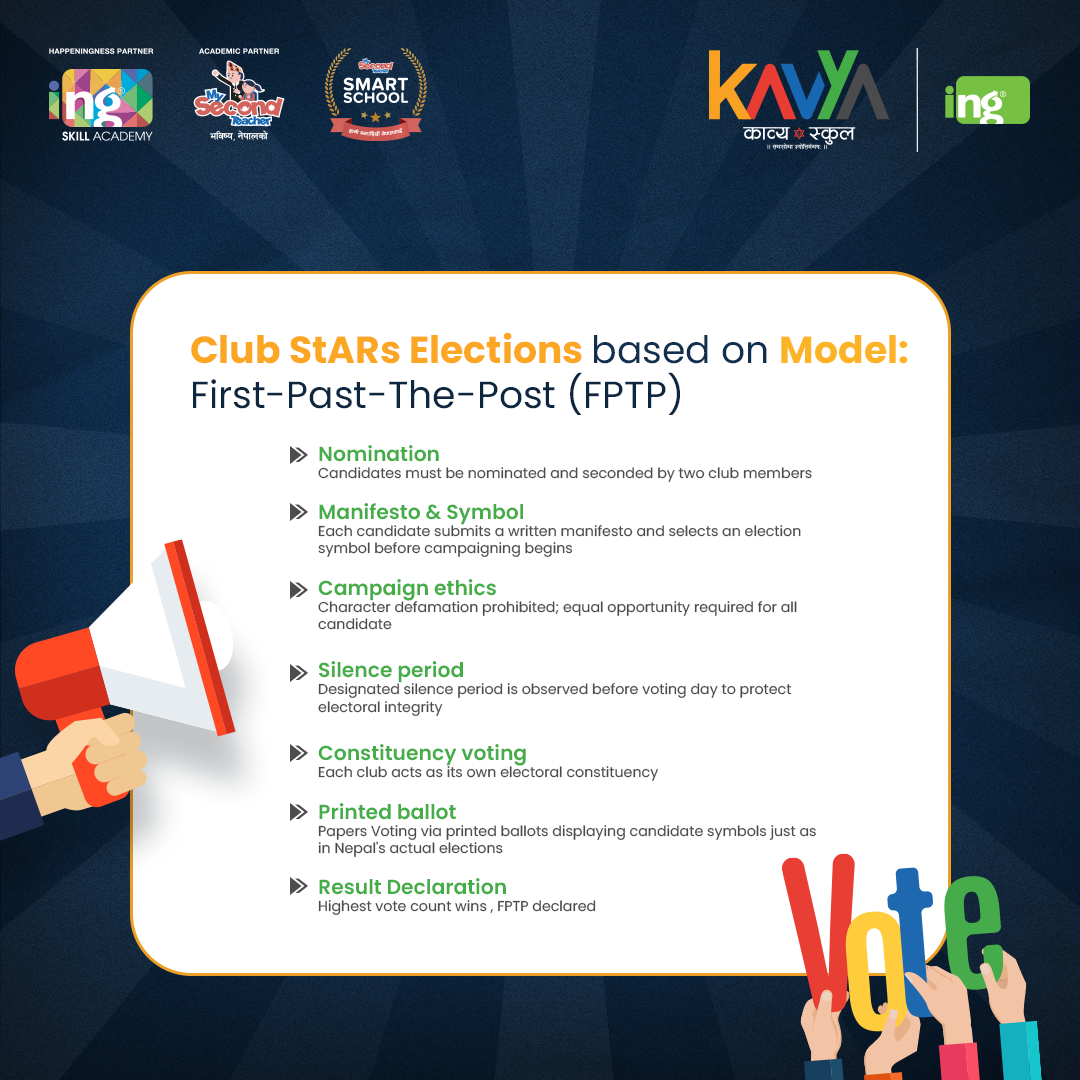 Club StAR Election
Running parallel to this, Grade 12 students may contest for the positions of Club President and Club Vice President through a majority-based indirect election, designed to reflect the mechanics of Nepal's presidential selection process.
Club President & Club Vice President Election: Electoral College Structure
Candidates apply directly to the Kavya Election Commission; no club-based nomination is required.
An Electoral College is formed comprising newly elected Grade 11 Club StARs, Grade 12 Club StARs, and all Class StARs.
In Round 1, a candidate must secure 50%+1 of total weighted votes to win outright.
If no candidate achieves a majority, a runoff (Round 2) is held between the top two candidates.
This ensures the President and Vice President hold genuine majority support, a key distinction from the FPTP model.
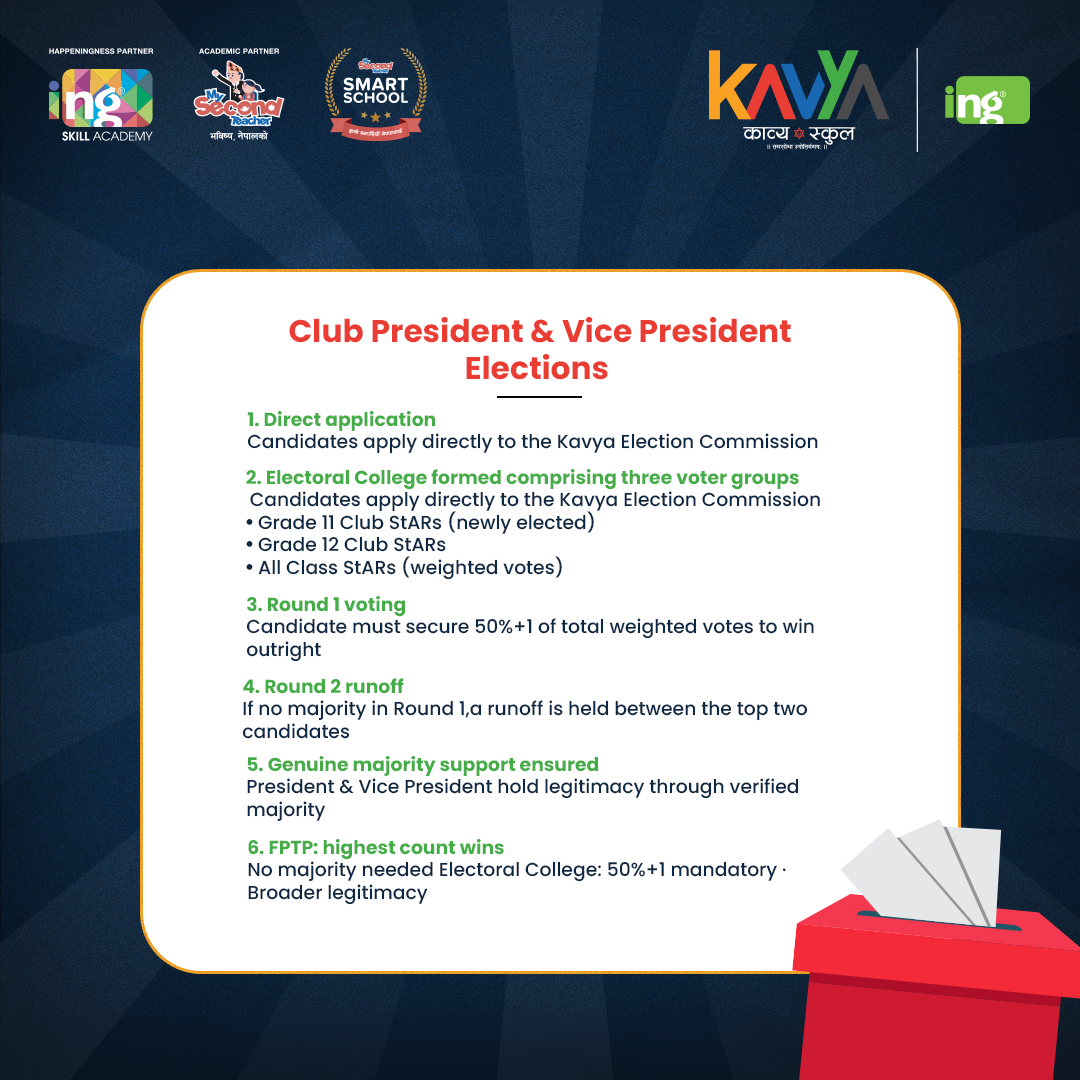 Club President and Vice President Elections
The Kavya Election Commission
Overseeing the entire process is the Kavya Election Commission, a student body of our Grade 11 Social Studies students, who are responsible for verifying nominations, enforcing campaign regulations, and declaring results. Modelled on Nepal's independent Election Commission, it introduces students to the concept of neutral institutional oversight, the bedrock of any functioning democracy.
The Commission's authority to approve or reject candidacy, regulate campaigning, and manage the electoral calendar gives students a firsthand appreciation of why independent election management is so vital in real democratic systems.
"Democracy is not just about voting. It is about the systems, institutions, and ethical norms that enable free and fair voting."
A Curriculum That Builds Citizens
The entire simulation is designed and administered by Grade 11 Social Studies students as part of their academic curriculum. But it is a school-wide event, with both Grade 11 and Grade 12 students stepping into roles as candidates, campaigners, constituents, and voters, making it a shared democratic experience across the whole school community
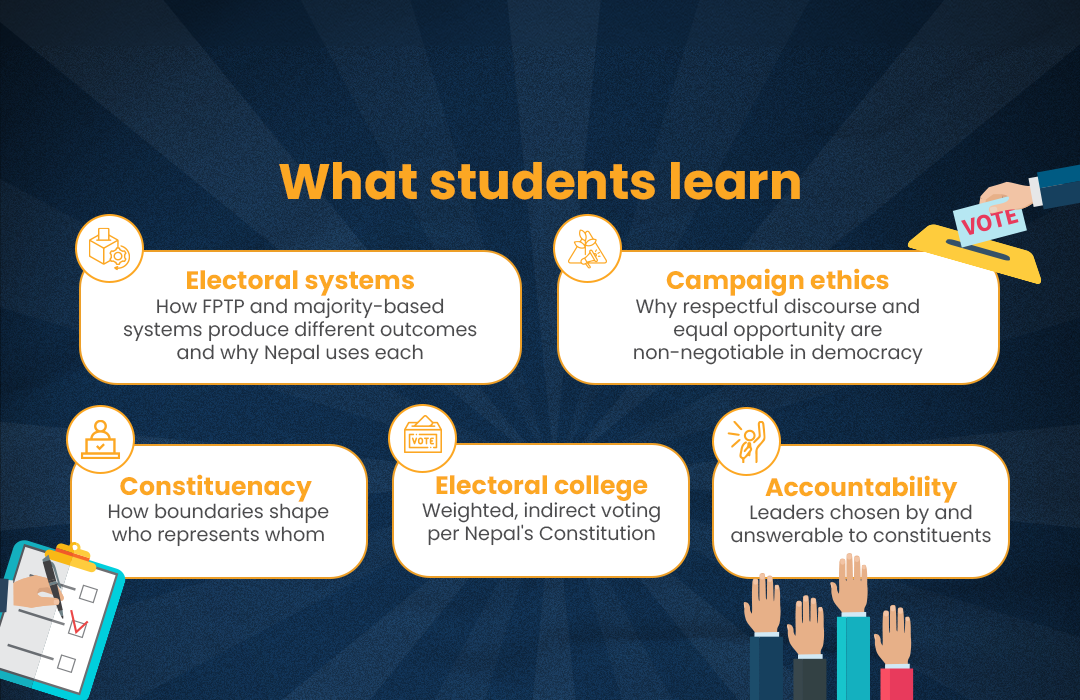
Through the process, students gain practical exposure to concepts that go far beyond any exam syllabus:
Electoral Systems in Practice: How FPTP and majority-based systems
produce different outcomes, and why Nepal uses each in different contexts.
Campaign Ethics: Why respectful discourse and equal opportunity are non-negotiable in a healthy democracy.
Constituency-Based Representation: How geographic or group-based boundaries shape who represents whom.
Electoral College Mechanisms: Weighted, representative voting and why some elections are indirect, lessons directly applicable to Nepal's Constitution
Democratic Accountability: What it means for leaders to be chosen by, and answerable to, the people they represent.
Nepal is a young democracy. Since the transition to a federal democratic republic, the country has held historic elections that have shaped its direction, and millions of young Nepali citizens will cast their first votes in the years ahead. The question is whether those votes will be informed ones.
At Kavya School, the answer begins in the classroom and then moves into the campaign trail, the ballot box, and the announcement of results. Every student who participates in the Election Simulation leaves with something rare: not just knowledge about how elections work, but the lived experience of participating in one.
They understand that:
A ballot symbol is more than a picture; it is a candidate's public identity.
A manifesto is a promise to constituents, not just a document for a teacher.
A silence period protects the integrity of democracy, not just the comfort of candidates.
An Electoral College is not an obstacle to democracy; it is one of its instruments.
These are the citizens Nepal needs. And Kavya School is committed to preparing them, one election at a time.
The Kavya Election Simulation is part of our commitment to holistic, civically engaged education. We believe every student who learns to vote well today will help build a stronger Nepal tomorrow.
FAQs
Why does Kavya run an election simulation?
At Kavya, students don't just learn about democracy; they run one. The Election Simulation prepares every student to vote, lead, and participate as an informed citizen of Nepal.
Is the election simulation part of the formal curriculum or an extracurricular activity?
Both. Grade 11 students run it as part of their curriculum and the whole school participates as candidates, campaigners, and voters.
What skills does a student develop that are useful beyond school?
Systems thinking, ethical leadership, public communication, and civic knowledge and skills built here that directly serve careers in law, policy, business, and beyond.
My child is academic but introverted, will the election simulation benefit?
Yes. Whether you manage rules on the Election Commission or write a compelling manifesto, there is a role for every kind of student.
Is Kavya the only school in Nepal doing curriculum-integrated elections?
Yes ,Kavya is the first higher secondary school in Nepal to run a curriculum-integrated election simulation covering two electoral systems, a student Election Commission, and school-wide participation with real outcomes.
Does election simulation help with college admissions?
Yes. A student who ran a real electoral process for 200+ peers makes a specific, verifiable claim in their application , not a generic one. That is what universities in India, the UK, US, and Australia look for.
What do I gain from this program as a student?
Real experience in leadership, ethical decision-making, and public communication , skills no NEB exam covers but every university and employer asks for.
Why does the simulation use two electoral systems?
Because Nepal itself uses two. FPTP for local elections, fast and decisive. An Electoral College for the President, requiring majority support. Students experience both, not just read about them.